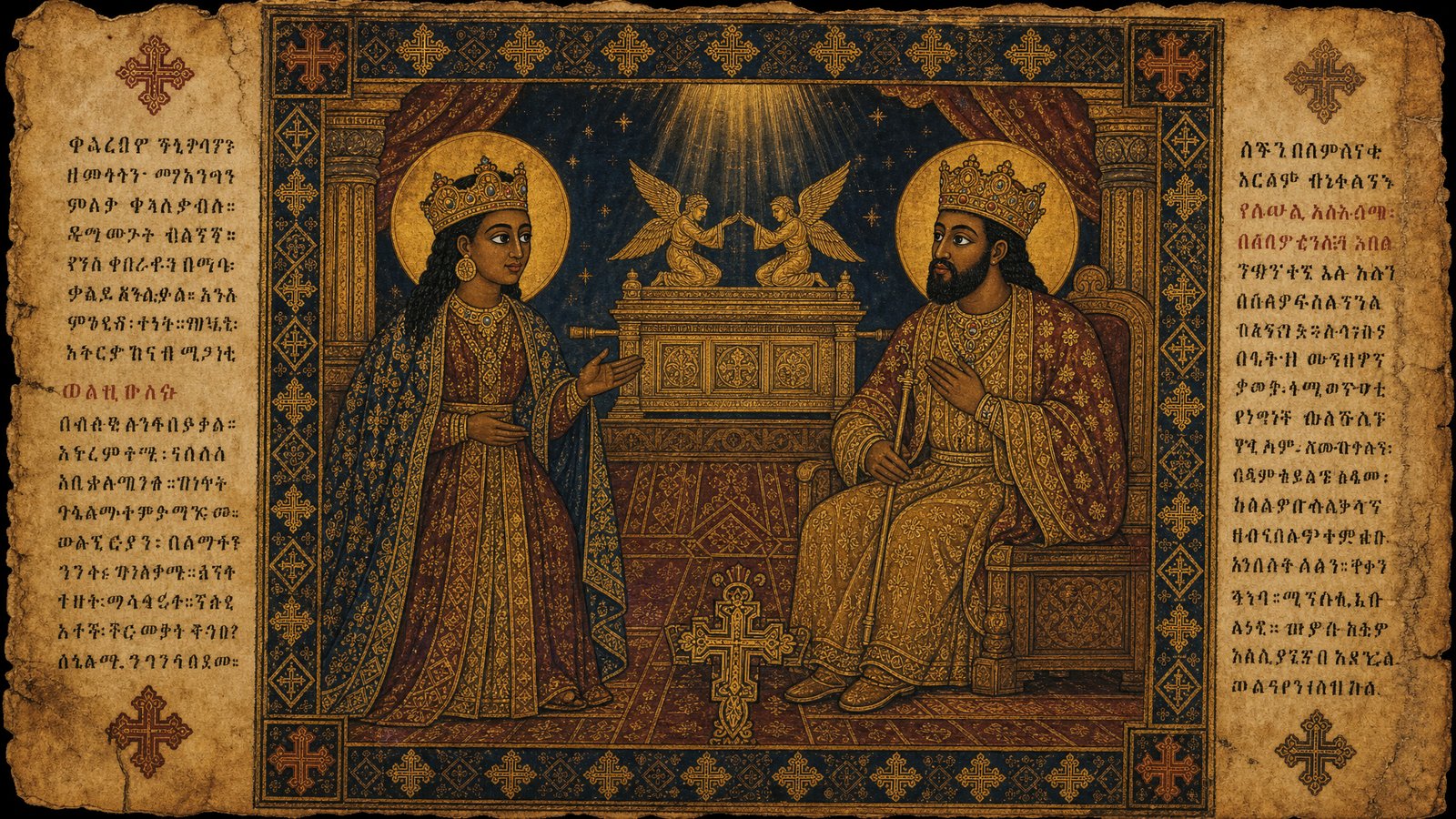
The Kebra Nagast
"The Glory of Kings"
The 14th-century Ethiopian chronicle tracing the biblical connection between the Queen of Sheba, King Solomon, and the Ark of the Covenant — and establishing Ethiopia's unique covenant relationship with the God of Israel.
What is the Kebra Nagast?
The Kebra Nagast (Ge'ez: ከብረ ነገሥት, "Glory of Kings") is a 14th-century Ethiopian chronicle that narrates the origins of the Solomonic dynasty and traces the lineage of Ethiopian rulers from King Solomon and the Queen of Sheba. It is considered one of the most important texts in Ethiopian Orthodox Christian tradition and a foundational document for understanding Africa's deep biblical connections.
First translated into English by E. A. Wallis Budge in 1922, the Kebra Nagast draws upon biblical narratives, Judaic traditions, Arabic legends, and indigenous Ethiopian oral histories. It interweaves the story of Solomon's wisdom, the Queen of Sheba's journey, the birth of their son Menelik I, and the dramatic account of the Ark of the Covenant's transfer from Jerusalem to Axum.
Historical Timeline
Key events connecting the Kebra Nagast narrative to biblical and Ethiopian history.
Queen Makeda visits King Solomon
Birth of Menelik I, son of Solomon and Makeda
Menelik visits Jerusalem; the Ark brought to Ethiopia
Ethiopia adopts Christianity under King Ezana
Nine Saints spread monasticism in Ethiopia
Kebra Nagast compiled in its current form
Solomonic dynasty restored by Yekuno Amlak
Emperor Haile Selassie, last Solomonic ruler
Key Themes
Five major themes from the Kebra Nagast with biblical cross-references.
The Kebra Nagast describes Queen Makeda of Ethiopia (the biblical Queen of Sheba) as a powerful, wealthy, and intellectually curious monarch who traveled to Jerusalem to test Solomon's wisdom. The biblical account confirms she came with "a very great train, with camels that bare spices, and very much gold, and precious stones" (1 Kings 10:2). The Ethiopian tradition provides rich detail about her court, her conversion from sun worship to the God of Israel, and the exchange of wisdom between two of the ancient world's greatest rulers.
Scholarly Perspectives
Ethiopian Orthodox Tradition
The Kebra Nagast is sacred history, affirming Ethiopia's covenant role in salvation history.
African Biblical Scholarship
The text preserves authentic African theological traditions that predate European colonialism.
Western Academic Analysis
A medieval literary and political document with roots in older oral traditions and biblical narratives.
Archaeological Evidence
Excavations at Axum confirm the existence of a sophisticated pre-Christian and early Christian civilization.
Geographic Context
Capital of the Aksumite Empire; home of the Church of Our Lady Mary of Zion
Homeland of Queen Makeda; debated between Ethiopian and South Arabian origins
Where Solomon's Temple housed the Ark; Menelik's destination
Capital of the Kingdom of Kush; home of the Candace queens (Acts 8:27)
Rock-hewn churches built as a "New Jerusalem" in the 12th–13th century
Ancient port through which Christianity and trade entered the Horn of Africa
“Ethiopia shall soon stretch out her hands unto God.”
— Psalm 68:31 (KJV)
Content curated by Pastor John W. Jones, Th.D. | Based on scholarship by Yamauchi, McCray, Budge, and Ethiopian Orthodox tradition